
Linkpost June 2025
Economies, Structures of things, and Public & Private Health

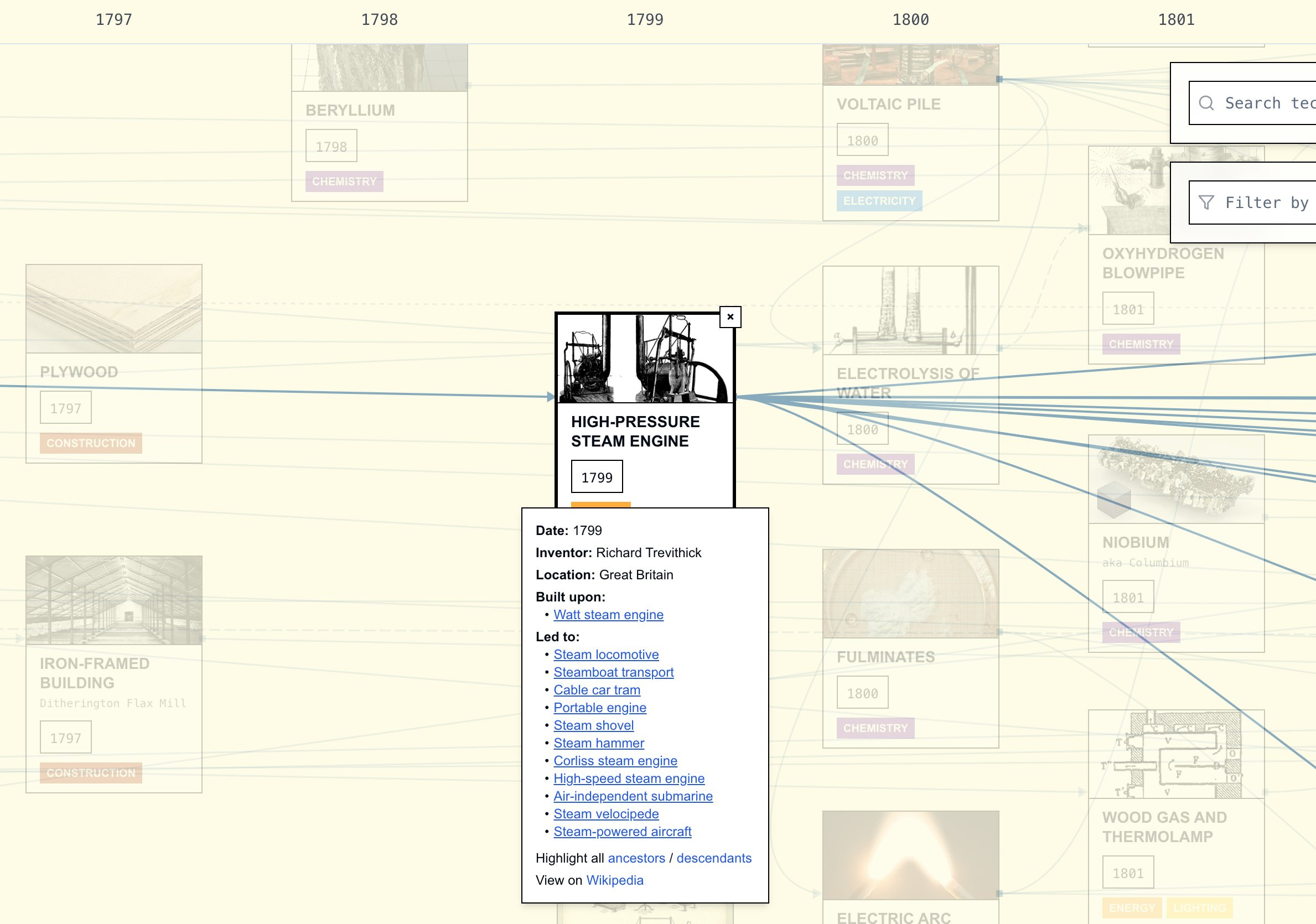
Étienne Fortier-Dubois has created a historial tech tree - something that nerds and fans of the video game Civilization series (like me) have been dreaming about in the back of our minds for years. He writes about it in issue 10 of Asterisk Magazine. The entries are more complicated than I imagined - there are 1,780 technologies (compared to 77 in the in the full game of Civ VI with all DLCs, a 23x difference, excluding civics.) It is super fine-grained!
You can also search specific entries, by people, by time and by city/country of invention.
Nicholas Decker talks about India’s dilapidated courts, with sources that estimate it costs up to 10% of GDP. You think Californian permitting is slow? As of 8th June 2025, ~40 properties’ worth of permitting for rebuilding houses that burnt down in the LA Palisades fire (January) has been issued, out of ~6800. At the current rate, all permitting will be done in 53 years.
The Indian government estimated that, at current capacity, it would take 324 years to clear all of the cases. That was in 2018. Since then the number of pending cases has doubled.
The process by which a lack of court capacity impact GDP is also explained: misallocation of labour in firms, where firms do not fire, do not hire, and do not outsource (and specialise) to the extent that they would if there was a functional legal system to resolve land, labour and firm-firm disputes. The lack of judiciary capacity also makes it relatively hard for multinationals to enter and operate in the country. This delays the transfer of effective technologies and management practices into India - in practice, other countries would poach them away.
Leopold Aschenbrenner compiles economics papers from Chad Jones, on long-run economic growth. Highly recommended to longtermists: Jones’s approach, focused on the value of “new ideas”, is general enough to apply to the future and much more concrete than “superintelligence will make all predictions moot”, because it’s a model based upon historical data. Jones was one of the authors of “Are Ideas Getting Harder to Find?”, a canonical starting point in progress studies discussion.
No Magic Pill writes about tooling for semiconductor fabs, with one tool as example. Good for industrial literacy.
Common Tech Jobs Described as Cabals of Mesoamerican Wizards, in a style much like Slate Star Codex.
Colour theory, but the physics of it.
Scientific journals and how they changed over time, in order to answer the question “Why Is ‘Nature’ Prestigious?”
A different way to look at the value of art. Personally, I think the value of art can and does increase over time, as we explore more of art-space and find better aesthetic fits for every observer - it’s not just a function of novelty. (I say this mainly because I listen to 10 songs on my Spotify on repeat, and rarely vibe with new ones.)
All these are from the archive of Étienne Fortier-Dubois.
Will AI step in as consultants in decision-making about preclinical assets? Looking at the various decision points for go/no-going a typical asset, and where AI could or could not fit - from Owl Posting.
You’ve heard of broad-spectrum antivirals. Broad-spectrum vaccines. Broad-spectrum antivenoms.
But have you heard of broad spectrum cancer treatments? Some avenues of investigation that might make more of them - like the original chemotherapy and radiotherapy, that target characteristics of a wide range of different cancers - feasible in the near future. from Sarah Constantin.
Big news - an improved methodology finds more happiness than previously reported, hidden in the same scale - due to rescaling of the 1 to 10 ladder, into territory equivalent to being beyond the first 10.
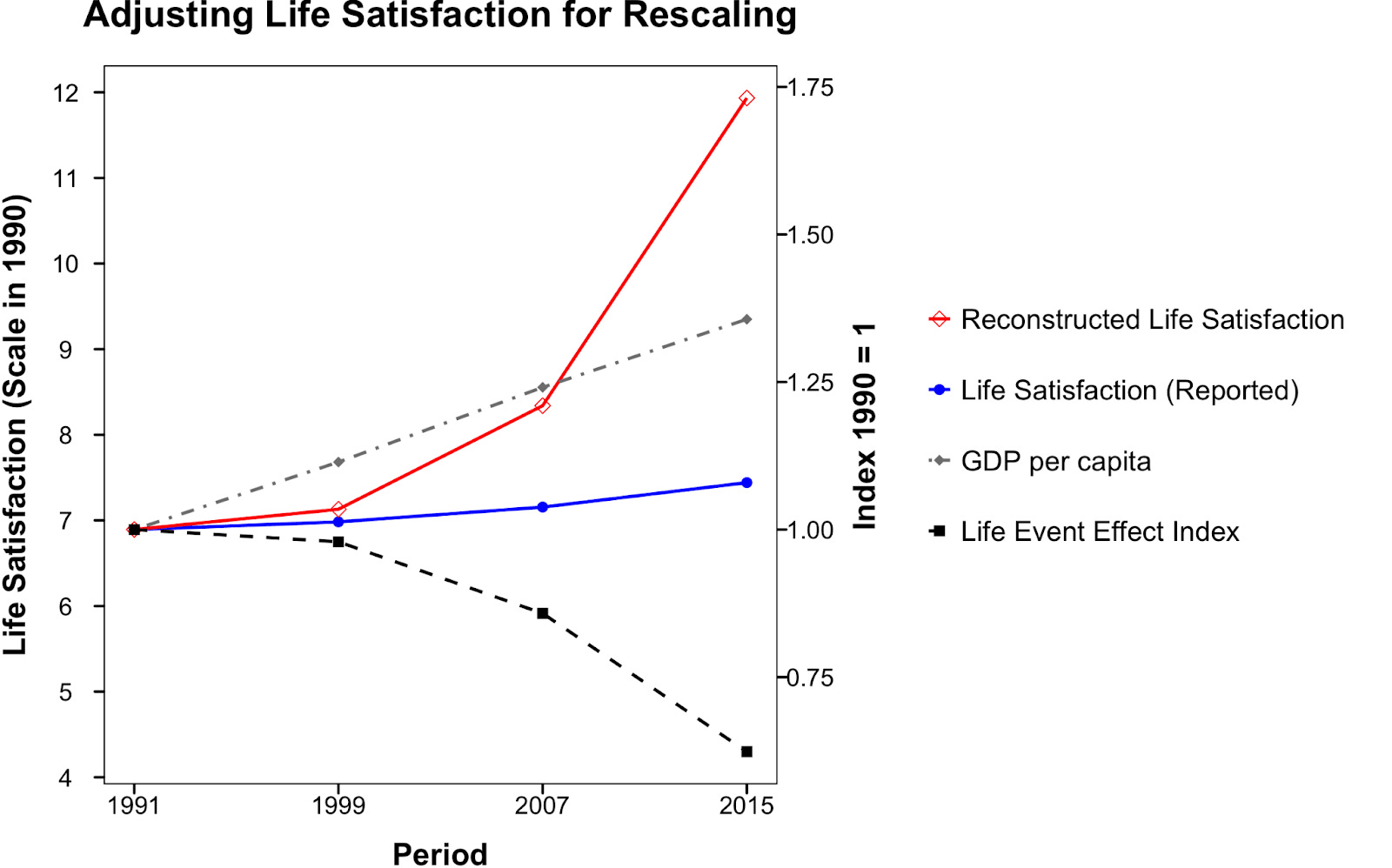
We are getting better at measuring empirical well-being! - Charlie Harrison, via EA Forum
Foundational models have a ways to go in mechanical modelling yet. - Adam Karvonen
Bell Labs was the first of a series of big, centrally funded industrial laboratories in the 19th century. From the 1950s, other corporations formed their own subsidiary labs, chasing opportunities like Bell’s invention of the transistor was. But through the last quarter of the century, these labs have been gradually integrated closer with existing business pressures, or spun down. It seemed that Bell Labs, as first mover, captured most of the best scientific work and prestige from that work, starting a “bubble in the meta-idea of economically unjustifiable investments in pursuing basic research” - given that “there’s a well-known phenomenon that technological progress is often driven by bubbles”. The ideal is romantic for the scientists, it worked for Bell, it led to overwhelming positive technological externalities - but the Bell Labs model didn’t prove a high enough rate of return to go on forever. - Construction Physics
There is about a 50% chance across all categories of important inventions of not being unique. This means 50% were a unique effort for its time. - Construction Physics
Best parts from The Gentle Singularity, Sam Altman, June 2025.
The rate of technological progress will keep accelerating, and it will continue to be the case that people are capable of adapting to almost anything. There will be very hard parts like whole classes of jobs going away, but on the other hand the world will be getting so much richer so quickly that we’ll be able to seriously entertain new policy ideas we never could before. We probably won’t adopt a new social contract all at once, but when we look back in a few decades, the gradual changes will have amounted to something big.
If history is any guide, we will figure out new things to do and new things to want, and assimilate new tools quickly (job change after the industrial revolution is a good recent example). Expectations will go up, but capabilities will go up equally quickly, and we’ll all get better stuff. We will build ever-more-wonderful things for each other. People have a long-term important and curious advantage over AI: we are hard-wired to care about other people and what they think and do, and we don’t care very much about machines.
A subsistence farmer from a thousand years ago would look at what many of us do and say we have fake jobs, and think that we are just playing games to entertain ourselves since we have plenty of food and unimaginable luxuries. I hope we will look at the jobs a thousand years in the future and think they are very fake jobs, and I have no doubt they will feel incredibly important and satisfying to the people doing them.
The latest analysis of human impacts on on wild animal suffering - Bentham’s Bulldog
Everyone knows pain follows a power law intensity. I include this article to ensure that now everyone knows that everyone knows it. - Ways of Seeing
Three priority questions to investigate in animal welfare market dynamics.
Using the market structure hammer on the nail of animal farming.
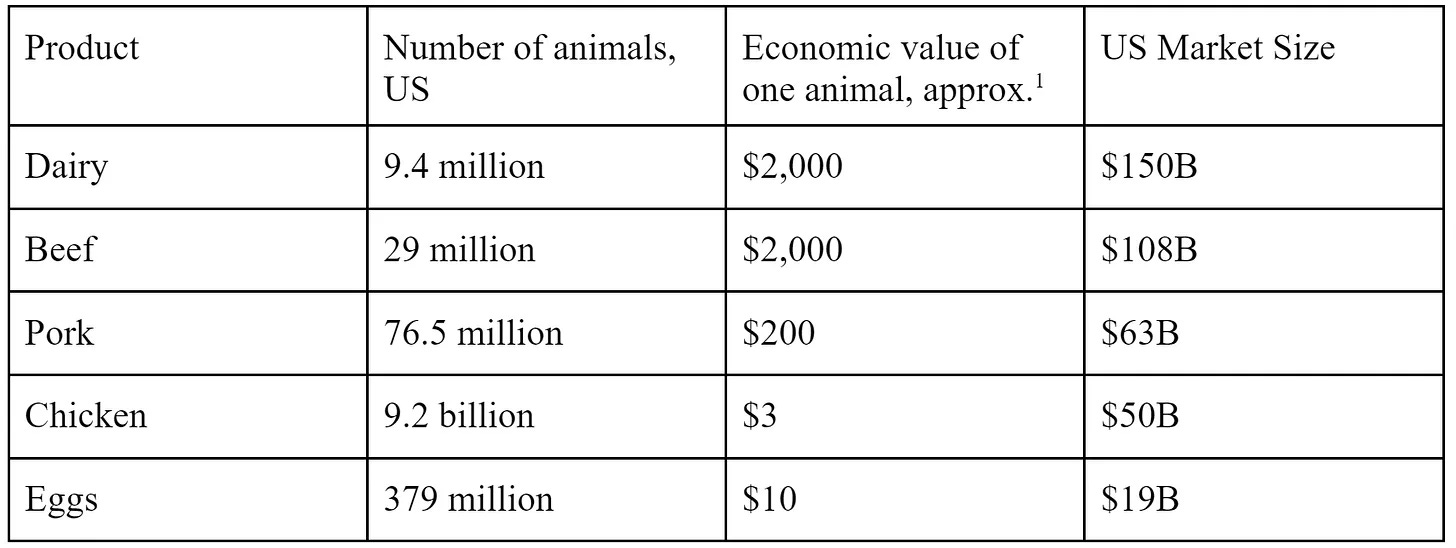
Both above by Robert Yaman at The Optimist’s Barn.
Just so much good stuff in Yuxi on the Wired’s Structure and Interpretation of the Chinese Economy. Best Essay of June 2025.
State of Autonomous Vehicles - Scenarios for Widespread UK Adoption - Tym Syrytczyk.
Interesting things from this report:
Chinese robotaxi firms (Apollo, WeRide and Pony) are setting up to be super export oriented. Making as many foreign city operation deals as they can, from the UAE, Turkey and Switzerland to various western European countries and South Korea.
Waymos recoup their costs at current usage rates (30 trips/day) in around one year, even costing $125,000-$150,000 per vehicle.
“the first 100 Waymos now cover 20% of all Uber rides in Austin.”
Several “big if true” ideas to know in global health and development. Noise pollution - a bit like air pollution; Flooring - a bit like sanitation; and biodiversity conservation. The part on biodiversity conservation (vultures) is the only idea I’ve seen on the EA forum before. - Deena Mousa, Under Development
The integrity of OpenAI is not doing very well under Altman (10k words of quality reporting) - The Midas Project & The Tech Oversight Project.
Very long post regarding the nature of current LLM systems, its history, and predictions about alignment. The predictions seem to flow obvious, but actually track very well. “Why are all LLMs convergent on ChatGPT?” - oh, that’s why. The piece is opinionated and the middle part has the most opinions and is a slog. - nostalgebraist